
Equatorial Guinean by Blood, North Korean by Culture: Mónica Macías on Identity
Mónica Macías shared her unparalleled story of being the daughter of "one of the world's most brutal dictators" then being raised by Kim Jong Un's grandfather, with NYUSH.
Equatorial Guinea is a country on the west coast of Africa, home to around 2 million people. Once part of Spain's vast colonial empire, it remains the only Spanish-speaking country in Africa. In 1968, after nearly two centuries of Spanish colonial rule and growing pressure from independence movements and the United Nations, Equatorial Guinea held its first presidential election, electing Francisco Macías Nguema as the first leader and face of the newly sovereign country. His presidency would leave a profoundly controversial mark on the country's history. His daughter, Mónica Macías, was born into history itself, but at just six years old, she was sent to Pyongyang, North Korea, where she grew up under the protection of Kim Il Sung, the country's founding leader and grandfather of current leader, Kim Jong Un. She went on to live in South Korea, China, Spain, New York City, and London. Growing up across such different political and cultural environments, and speaking primarily Korean until adulthood, Mónica found herself struggling with a common question: Who am I?
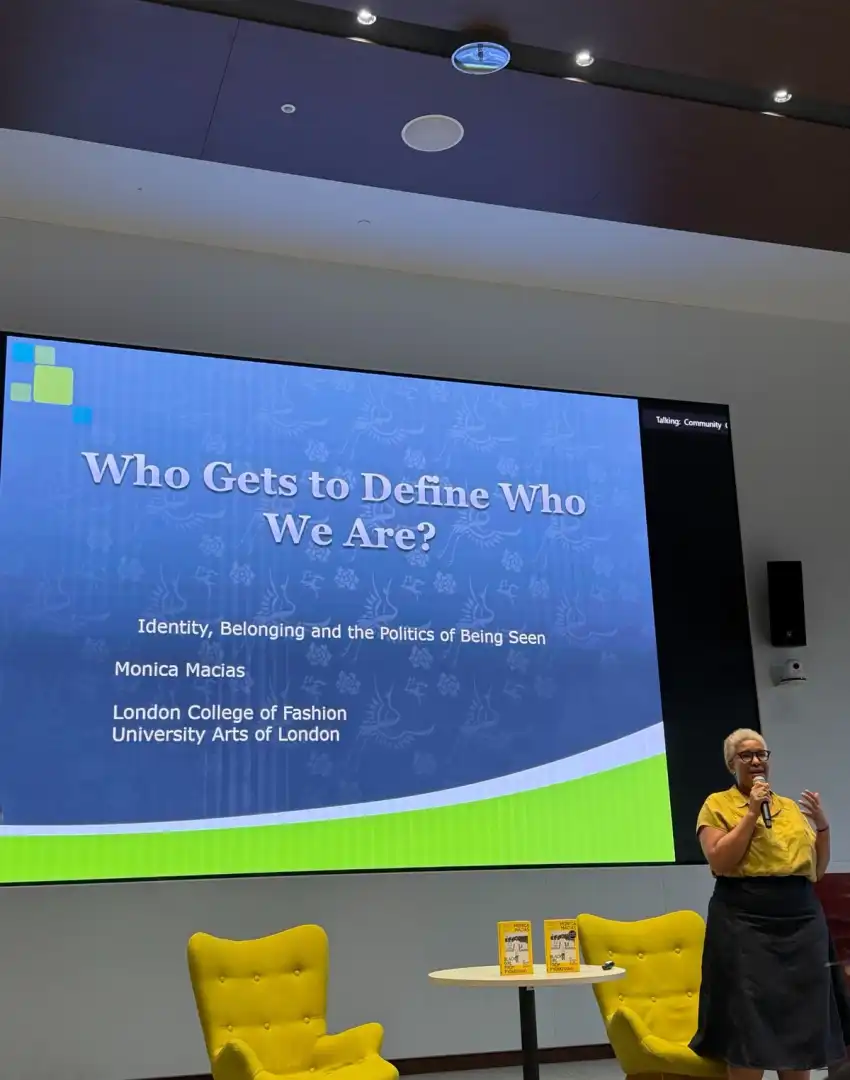
She writes about her struggles and search for identity in her memoir, Black Girl from Pyongyang: In Search of My Identity. On September 22, 2026, NYU Shanghai’s Writing Department welcomed Mónica Macías for a two-hour speaker event and Q&A centered on identity, belonging, and the politics of being seen. For an audience of students who have crossed borders, navigated different languages, and experienced the same uncertainty of belonging, her story was especially relevant.
Mónica began by describing her birthplace, Equatorial Guinea, and how her father had been attempting to build a newly independent country with limited infrastructure and educational resources from “what Spanish colonialism had left behind.” Believing that the younger generation would determine the country's future, he had emphasized the importance of their education. With few educational opportunities available, he turned to allied countries, including China, the Soviet Union, Cuba, and North Korea. Mónica and two of her siblings were sent to Pyongyang, while another brother was sent to Fidel Castro's Cuba.
According to historical accounts, Francisco Macías sent his children abroad shortly before he was overthrown by his nephew, Teodoro Obiang Nguema Mbasogo, in 1979, who is still president today. Francisco was accused of political repression, genocide, and treason, and was subsequently tried and executed. At that time, Mónica was six years old, trying to understand why she was in North Korea and why her parents were not staying with her. She wouldn't understand the extreme political climate until her research much later. Instead, her memories were of Pyongyang's beautiful scenery, kind people, and the place she eventually came to recognize as home.
Throughout her talk, Mónica repeatedly returned to the difference between identity and identification. Identity, she explained, is how we understand ourselves, while identification is how others understand and categorize us. Mónica could feel culturally Korean, having spent her childhood in Pyongyang, but others might never recognize her as Korean because of her appearance. She described the complicated politics of being seen by society through such factors: race, gender, nationality, class, religion, language, and geography.
In 1994, Mónica made the hard decision to leave Korea to get a better understanding of her past and research her father, moving to Spain. She described feeling lost in translation, not only linguistically but culturally. Even ordinary greetings became unfamiliar; in Korea, she was accustomed to bowing to friends, whereas the norm in Spain was hugs and cheek kisses. Returning to Equatorial Guinea brought another kind of unfamiliarity. Despite being her passport nationality and the home of her family, she struggled to communicate with relatives and adjust to the food and noise. She was also very unsure of any potential relationship with her uncle, the country's current president, whose government had Mónica’s father executed by firing squad. The place that one could assume was naturally her home did not necessarily feel like one.
She recalled growing up with a biased understanding of the United States, one that made the country seem “frightening and distant.” Wanting to know if these accusations were accurate or not, she came to NYC, where she encountered American perspectives on North Korea, which coincidentally thought the same of Pyongyang. The United States she had heard about in North Korea was not the United States she experienced, just as the North Korea portrayed in Western media did not entirely resemble the country of her childhood. She emphasized that sharing her experiences was not an attempt to defend any government or political leader. Instead, she wanted to defend her own version of events and encouraged the audience to conduct their own research and form their own conclusions rather than blindly trusting anything or anyone. This desire to reclaim her narrative was also central to why she wrote her memoir, along with the impacts of colonialism and decolonization. To be able to leave a record when the history of Equatorial Guinea and her family had so often been told through the perspectives of others.
Her father, Francisco Macías Nguema, is largely remembered as one of history’s most brutal dictators, yet through over 3000 interviews with people who knew him, she encountered individuals speaking on his role in gaining Equatorial Guinea's independence. He may have caused terrible events that cannot be excused, but his other actions cannot be forgotten either. History, perhaps more than anything, cannot be taught or written in black and white. The same historical figure can be remembered differently by those who knew them personally, those who lived under their leadership, and those who only know of him through textbooks. We need to question how historical narratives are constructed, whose voices are included, and whose experiences are accounted for. Individuals cannot always be reduced to their best or worst moments, even when those moments may be essential to understanding history.
At the end of the event, I asked Mónica, “Growing up in North Korea, only knowing the history you lived, and later learning the surrounding political context and historical background, how did that change your memories?” She answered that it was “very hard.” She then followed by saying that learning the Western narrative had been lies was “the happiest moment[s] of [her] life.”
Throughout the conversation, it was quite clear that many students connected with Macias’ experiences. They laughed with her as she mentioned how she never even liked kimchi, and cried with her when she advised students to be “faithful to yourselves.” In a school that talks about identity and belonging so often, she still managed to leave the audience with an echoing thought: “Who gets to define who we are?”
Edited by: Ari Harris, Serena Cajigal