
Ethnic Violence in Myanmar Demands International Attention
The international criminal justice system needs continued attention and pressure from global civil society, and the case currently proceeding against Myanmar at the ICJ is no exception.
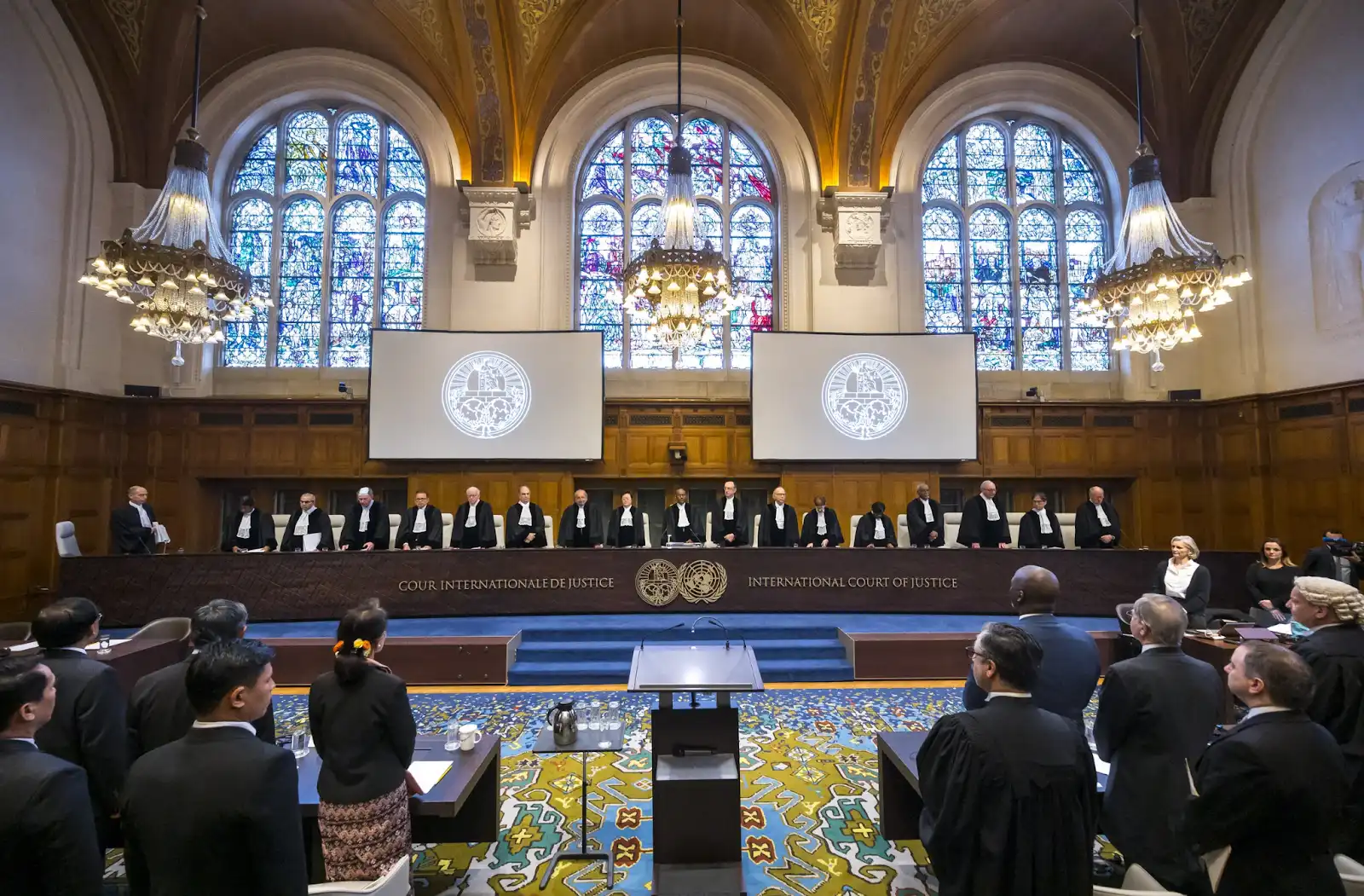
Photo by UN Photo/ICJ-CIJ/Frank van Beek
Ethnic-based violence continues to be on the rise in the world’s trouble spots. The ongoing genocide being raged against Palestinian civilians, the genocide and continued war in Sudan, and long-term fighting in the Democratic Republic of the Congo, are just a few of the many breaches of international law. Yet, the ongoing military coup in Myanmar (previously known as Burma) and ensuing ethnic violence is one that has gained relatively minimal media attention. This is the first case at the International Court of Justice (ICJ) where the prosecuting state was one not only in a different region as the accused but also had minimal direct impact from the violence – a historic circumstance.
As of 2026, there are currently 11 states intervening in this case, and proceedings are still ongoing. Hearings opened on Jan. 12, and Myanmar’s representatives claim that no international regulations were breached. Ko Ko Hlaing, a lawyer serving in Myanmar’s defense, argued that among other included evidence, the outcomes of a fact-finding mission were “rudimentary and partisan,” and that Myanmar had been defending itself against “terrorists” in the northern Rakhine state, where the violence took place. Over 700,000 Rohingya fled to Bangladesh, where there are currently over one million refugees from Myanmar.
According to Human Rights Watch, in Aug. 2017, security forces in Myanmar launched a horrific campaign of violence against the Rohingya. In Nov. 2019, The Gambia began officially bringing forth its case against Myanmar, citing “alleged violations of the Genocide Convention,” as was revealed in a press release from the ICJ. Here, The Gambia declared Myanmar had an obligation to end the ethnic violence and give reparations “in the interest of the victims of genocidal acts who are members of the Rohingya group, and that it must offer assurances and guarantees of non-repetition.” It took until Aug. 24, 2023, a deadline that had been pushed back multiple times, for Myanmar to file a counter-memorial to multiple reports done by both the Court and The Gambia.
Even though fighting in Myanmar has been raging for years, with ethnic violence and genocidal campaigns being called out by many NGOs, there continues to be limited media exposure regarding the extent of the humanitarian crisis in Myanmar. Using this ICJ ruling as an example, one of the requirements the ICJ put on Myanmar was to ensure the security of people displaced from ethnic violence. However, this begs the question, have any positive trends in population actually been seen in the country?
The short answer is no. According to the Internal Displacement Monitoring Centre, the number of IDPs (Internal Displaced People) in Myanmar started at 457,000 in 2019, the year the ICJ case was filed. By 2023, with the ICJ ruling in place, this number jumped to 2.3 million. It is important to note that, while the ICJ has no jurisdiction of its own, its rulings are still legally binding to its member states.Yet, considering the little to no media attention given to the violence faced by the Rohingya and this case, people will continue to be forced out of their homes and killed.
With this case still in process, it is absolutely crucial that international actors — such as media, governments, and civil society — push for greater attention to the Rohingya genocide and demand justice. The international criminal justice system greatly differs from domestic courts. Without formal enforcement mechanisms, it is the duty of all global citizens to continuously pressure whichever institutions and mechanisms are present to demand accountability.
It may be easy to claim that international criminal justice systems are weak and just end there, but it is important to understand why the system works this way and what civil society can do to support action. International law, particularly in regards to criminal law, is only as strong as states want it to be. While this is certainly a limitation to enforcement and deterrence, as many scholars and practitioners of international criminal law have long pointed out, there exists a sliver of hope for civil society to apply pressure on domestic politicians to uphold and commit to global criminal justice. Call your representatives, do your research, and speak up about world news you may not see directly on the main page of a news website. The case of Myanmar at the ICJ is a historic one, and holds great importance to deliver even some justice to the Rohingya people. It is crucial that those who have the privilege to continue demanding justice do so.